
New Supply Offers : October 2026
TFO Canada received 60 new supply offers in these categories:
- 41 – Food products and Beverages (including Seafood)
- 4 – Clothing (not including Footwear)
- 3 – Personal Care, Pharmaceuticals and Natural Health Products
- 5 – Home Décor, Giftware and Crafts
- 7 – Fashion Accessories
Sign in to your TFO Canada profile to view the suppliers that match your interests.
TFO Canada Launches TRISEG Across Africa, Asia and Latin America
In October, TFO Canada launched Trade for Resilient, Inclusive and Sustainable Economic Growth (TRISEG), a five-year initiative (2025–2030) funded by the Government of Canada through Global Affairs Canada. The first launches took place in Zambia (October 6), Nigeria (October 8) and Kenya (October 13), in partnership with the Zambia Development Agency, the Abuja Chamber of Commerce and Industry, and the Kenya Export Promotion and Branding Agency.
TRISEG works with Trade Support Institutions to help small and medium-sized enterprises (SMEs) grow and reach international markets through export-readiness support, digitalization, access to finance and climate resilience. The initiative will target 3,200 SMEs across 16 countries, including 2,133 owned or led by women and under-represented groups:
- Africa: Côte d’Ivoire, Ethiopia, Kenya, Madagascar, Mozambique, Nigeria, Senegal and Zambia
- Asia: Bangladesh, Indonesia, the Philippines and Vietnam
- Latin America and the Caribbean: Colombia, Guatemala, Honduras and Peru
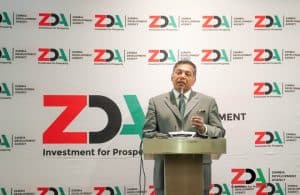
🔗 Read the Press Release for Zambia here
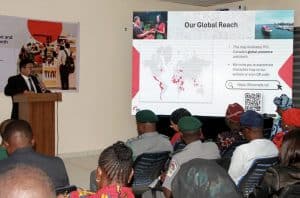
🔗 Read the Press Release for Nigeria here

🔗 Read the Press Release for Kenya here
Minister Sidhu concludes largest Team Canada Trade Mission to India in 30 years, securing new commercial contracts for Canadian businesses
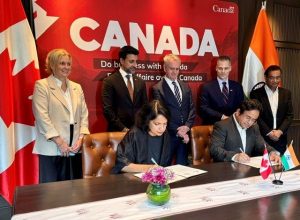 Source Photo: LinkedIn Post
From October 12 to 17, 2026, Minister of International Trade Maninder Sidhu led nearly 300 Canadian delegates to Mumbai and Bengaluru, the largest Canadian trade delegation to India in three decades. The mission resulted in 34 commercial agreements worth close to $300 million, in sectors including aerospace, clean technology, life sciences and agri-food. Minister Sidhu also met twice with India’s Minister of Commerce and Industry, Piyush Goyal, to advance negotiations on a Canada–India Comprehensive Economic Partnership Agreement (CEPA). Canada aims to grow two-way trade with India to $70 billion a year by 2030.
Why It Matters for Canadian Importers and Buyers
- India is already a major supplier to Canada: Canadian merchandise imports from India reached $9.7 billion in 2025.
- Frequent ministerial meetings suggest a trade agreement could be within reach, which would likely reshape tariffs on goods sourced from India.
- Until a deal is concluded, current tariff rates still apply, so importers should avoid adjusting prices or sourcing plans too early.
- Once the agreement text is released, its rules of origin will determine which goods qualify for lower duties, so it’s worth reviewing supplier documentation now.
Canada-Indonesia Comprehensive Economic Partnership Agreement (CEPA)
Source Photo: LinkedIn Post
The Canada–Indonesia Comprehensive Economic Partnership Agreement (CEPA) will enter into force on December 1, 2026. Signed in September 2025, it deepens Canada’s ties with Indonesia, a market of nearly 282 million people and a $1.9 trillion economy. Beyond reducing or eliminating tariffs, the CEPA covers services and investment, and includes provisions on sanitary and phytosanitary measures, technical barriers to trade, SMEs, labour, environment and women’s economic empowerment.
Why It Matters for Canadian Importers and Buyers
- The CEPA provides a more predictable and transparent framework for trade with one of the Indo-Pacific’s key markets.
- The agreement reaches deep into agri-food, textiles and apparel, and cosmetics; for example, Indonesia will phase out tariffs averaging 23.6% on most Canadian apparel exports.
- Preferential treatment depends on meeting rules of origin and having the right documentation, so trading partners should review these requirements before December 1.
- Provisions on sanitary and phytosanitary measures and technical barriers to trade aim to reduce non-tariff barriers, especially for food and agricultural products.
🔗 Read the Benefits of the Agreement: https://www.tradecommissioner.gc.ca/en/market-industry-info/free-trade-agreements/canada-indonesia-comprehensive-economic-partnership-agreement/cepa-benefits-industry.html
🔗 Read the Full CEPA: https://www.international.gc.ca/trade-commerce/trade-agreements-accords-commerciaux/agr-acc/indonesia-indonesie/cepa-apeg/text-texte.aspx?lang=eng
Before You Import: Key Information CBSA Says to Gather About Your Goods
Source Photo: LinkedIn Post
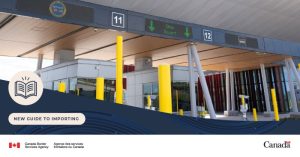
CBSA’s Guide to importing commercial goods sets out what businesses should know about their products before importing them into Canada. The second step of the guide focuses on gathering key information: a clear description of the goods and what they’re made of, their country of origin, whether they’re allowed into Canada, and whether they need permits or certificates from other government departments. It also flags goods that face special measures, such as alcohol and tobacco, goods subject to anti-dumping or countervailing duties, controlled goods, and goods made with forced or prison labour, which are prohibited.
Why It Matters for Canadian Importers and Buyers:
- Country of origin is where goods are made, produced or grown, not where they ship from; importers need proof of origin, and free trade agreements may offer lower duties.
- If origin is unclear, importers can request an advance ruling or national customs ruling through the CARM Client Portal.
- Some goods need permits, certificates, or inspections from other government departments, which CBSA administers at the border.
- Goods made wholly or partly with forced, or prison labour are prohibited, and importers must carry out due diligence.
🔗 Learn more: https://www.cbsa-asfc.gc.ca/import/guide-2-eng.html
📖 Read the report: https://www.cbsa-asfc.gc.ca/import/guide-eng.html
Government of Canada releases What We Heard reports on fighting forced labour
On October 8, 2026, the Government of Canada released two “What We Heard” reports on its summer consultations about fighting forced labour in global supply chains. The first covers Bill C-35, which would strengthen Canada’s ban on imports made with forced labour by creating a list of goods suspected of being linked to it. Importers of listed goods would have to show, when asked, that their products aren’t connected to forced labour. The second report looks at possible rules requiring some businesses to identify and address forced labour risks in their supply chains. Bill C-35 is still before Parliament, and no timeline has been announced.
Why It Matters for Canadian Importers and Buyers:
- Importers could be asked for information about their supply chains, so building traceability now is easier than doing it once a shipment is held at the border.
- Apparel and textiles, agri-food and seafood were specifically raised in the consultations, so buyers in these sectors are likely to face closer scrutiny.
- Industry asked that importers be judged on their good-faith diligence, with proportionate requirements for SMEs, so documented supplier checks could become key to compliance.
Global Trade Update (October 2026): Can developing countries unlock the potential of biodiversity?
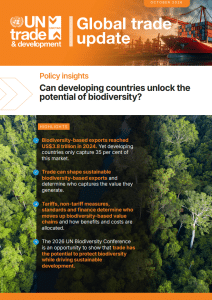
UNCTAD’s October 2026 Global Trade Update finds that global exports of biodiversity-based products, including food, beverages, natural ingredients and plant fibres, reached nearly US$3.8 trillion in 2024, about 17% of all merchandise trade. However, developing countries captured only about 35% of this market. Latin America and the Caribbean accounted for just 11% of exports, even though these products represent 28% of the region’s trade. The report highlights tariffs, standards and access to finance as key factors that determine whether producers can move beyond raw materials into higher-value products.
Why It Matters for Canadian Importers and Buyers:
- New natural materials are reaching the market, including pineapple-leaf fibre, banana-stem yarn and seaweed-based packaging.
- Natural fibres like banana and pineapple may face food safety and phytosanitary rules designed for fresh produce.
- From 2028, hemp and natural-fibre fishing nets will be easier to identify in customs and trade data.
🔗 Learn more: https://unctad.org/publication/global-trade-update-october-2026
📖 Read the Full Report: https://unctad.org/system/files/official-document/ditcinf2026d9_en.pdf
Trade Events
In Canada
COFFEE ASSOCIATION OF CANADA ANNUAL CONFERENCE 2026
November 12, 2026
November 18-20, 2026
CPMA—CONVENTION +TRADE SHOW VANCOUVER 2027
April 13-15, 2027
Internationally
November 14-15, 2026
AFRICA TRADE DEVELOPMENT FORUM 2026
November 23-24, 2026
TEXTILE ASIA INTERNATIONAL EXHIBITIONS & CONFERENCES 2026-KARACHI EDITION
December 5-7, 2026
Click here to view all trade events